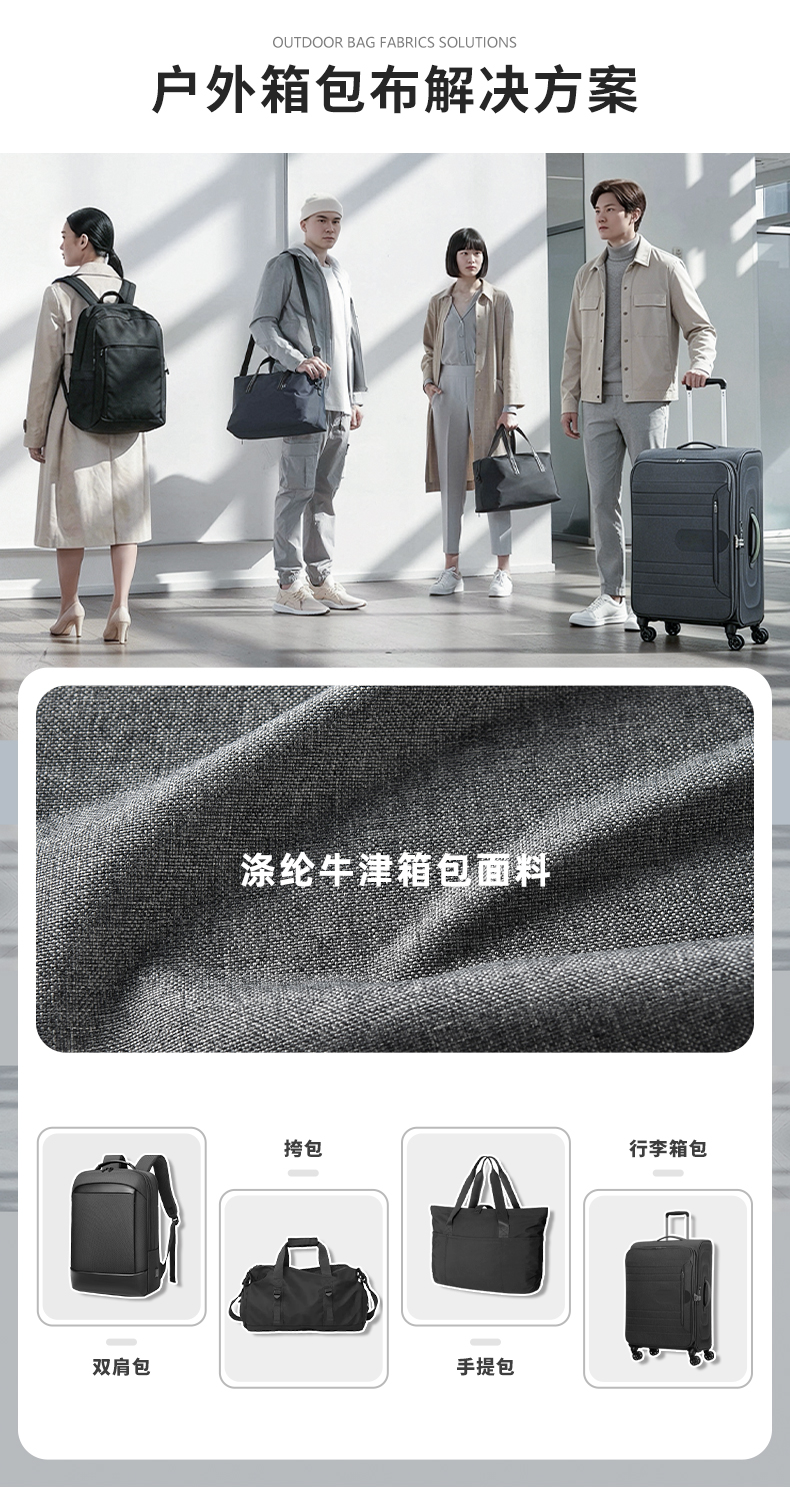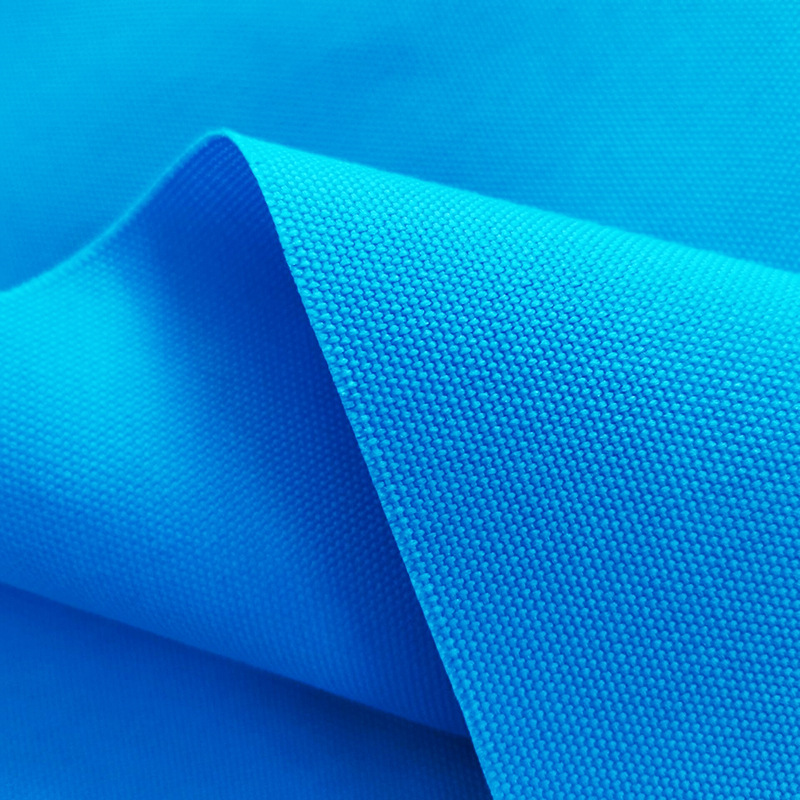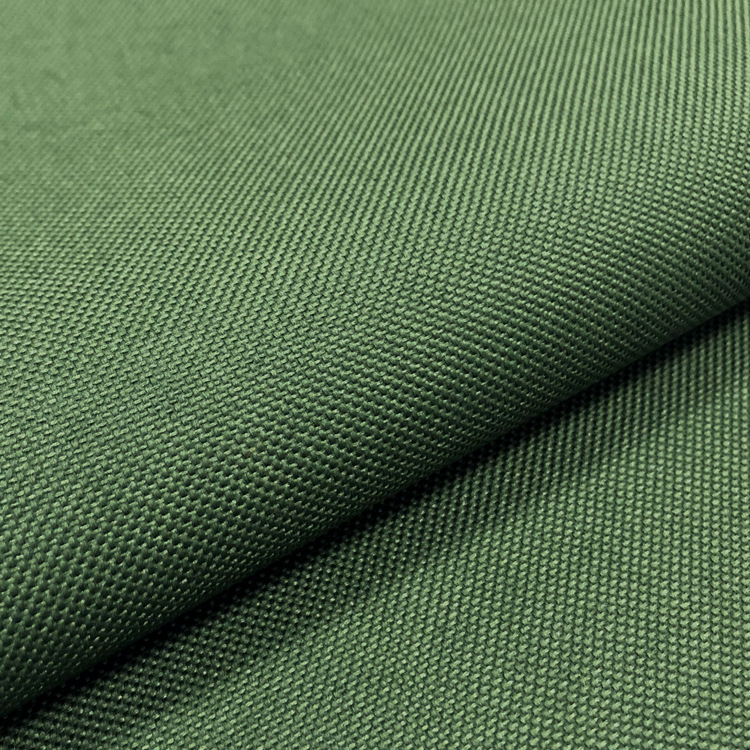
How to Select Yarn-Dyed Abrasion-Resistant Oxford Fabric for Bags and Luggage
What Does “Yarn-Dyed” Mean for Oxford Bag Fabric?
Yarn-dyed fabric is generally woven from yarns that already have color.
Different warp and weft colors, arrangements, and weave structures can create:
- contrasting warp and weft colors;
- two-tone effects;
- stripes;
- checks;
- mixed-color visual effects;
- other appearances created by yarn and weave combinations.
For backpacks, school bags, soft luggage, and other bag products, yarn-dyed construction can be part of the visual design, but it does not establish an abrasion result.
A sourcing specification should therefore continue beyond the term “yarn-dyed” and define:
warp yarn specification + warp color + weft yarn specification + weft color + warp/weft density + weave + color arrangement + finished fabric requirements.
Why Does Yarn-Dyed Not Automatically Mean Abrasion Resistant?
Yarn-dyed describes how color and fabric appearance are formed.
Abrasion resistance evaluates the condition of the fabric after repeated rubbing.
Actual abrasion performance may also depend on:
- fiber material;
- warp and weft yarn specifications;
- fabric density;
- weave construction;
- surface condition;
- finished weight;
- PU, PVC, or other finishing;
- test method and tested surface.
Two yarn-dyed Oxford fabrics that look similar can therefore show different abrasion performance.
Likewise, two fabrics described as 600D yarn-dyed Oxford fabric cannot be ranked by denier alone when their density, weave, or finishing differs.
Should Every Part of a Bag Use the Same Abrasion Requirement?
Not necessarily.
Main Body
The main body may need to balance:
- yarn-dyed appearance;
- product weight;
- hand feel;
- abrasion resistance;
- colorfastness;
- finishing.
Increasing fabric weight without considering the bag design may affect the total product weight and flexibility.
Bottom Panel
The bottom is more likely to contact tables, floors, or transport surfaces.
Depending on the project, buyers may focus on:
- surface abrasion;
- tear resistance;
- localized stress;
- finished weight;
- coating or finishing condition.
Corners and Seams
These areas may experience concentrated stress.
A fabric can remain visually intact while a seam area or local section is damaged by tearing or tensile stress.
Abrasion results therefore do not replace tear or tensile evaluation.
How Are 300D, 600D, and 900D Related to Abrasion?
The “D” in 300D, 600D, and 900D refers primarily to yarn linear density.
Denier is not an abrasion grade.
Two 600D bag fabrics, for example, may use different:
- warp/weft configurations;
- densities;
- weaves;
- finished weights;
- yarn-dyed structures;
- finishing systems.
These differences can change the finished fabric performance.
Buyers can use denier as one candidate specification, but actual abrasion performance should be compared under equivalent test conditions rather than inferred from the denier number.
How Should Abrasion Resistance Be Tested?
If abrasion resistance is a purchasing requirement, convert it into defined acceptance conditions.
The purchasing specification can identify:
- test method;
- tested surface;
- abrasive material;
- applied load;
- cycle conditions;
- endpoint or evaluation criteria;
- whether the specimen is base fabric or finished fabric.
Results produced using different methods or different specimen conditions should not be treated as directly comparable.
For example, if one supplier tests the finished face and another tests a different surface or construction, their cycle counts are not equivalent purchasing evidence.
Why Does Yarn-Dyed Bag Fabric Still Need Colorfastness Requirements?
Yarn-dyed and colorfastness are different concepts.
Yarn-dyed describes how the color becomes part of the woven structure.
Colorfastness evaluates how color changes under specified rubbing, light exposure, or other test conditions.
Depending on the bag application, buyers may need to consider:
- rubbing-related colorfastness;
- color change under light exposure;
- batch appearance consistency;
- other project-specific color requirements.
Batch color consistency should also be distinguished from colorfastness.
Batch consistency concerns the appearance relationship between production lots and an approved sample. Colorfastness concerns color change after a specified test exposure.
Can PU or PVC Finishing Affect Abrasion Evaluation?
Yes, because finishing changes the final fabric construction.
After PU or PVC finishing, the fabric may change in:
- finished weight;
- hand feel;
- stiffness;
- back-side condition;
- waterproof construction;
- friction surface.
The abrasion test should therefore specify which finished condition is being evaluated.
If the bag factory will cut and sew PU-finished fabric, abrasion data for an unfinished yarn-dyed base fabric should not automatically be treated as the result for the actual delivery material.
What Information Should Be Included in an Inquiry?
| Item | Information to Provide |
|---|---|
| Bag type | Backpack, school bag, luggage, tool bag, etc. |
| Fabric location | Main body, bottom, corner, or reinforcement area |
| Material | Polyester Oxford fabric or another specified material |
| Denier | Candidate structures such as 300D, 600D, or 900D |
| Warp/weft | Confirm each yarn direction separately |
| Yarn-dyed design | Warp/weft colors, arrangement, and physical sample |
| Density | Warp and weft density |
| Weave | Plain, twill, check, or another construction |
| Weight | Finished fabric weight |
| Width | Usable width |
| Finishing | PU, PVC, or another project requirement |
| Abrasion | Method, tested surface, and acceptance criteria |
| Other properties | Tear, tensile, colorfastness, as applicable |
Sample and quotation comparisons become more meaningful when these key conditions are aligned.
How Should a Supplier Be Evaluated?
A buyer can check whether the supplier asks for and clarifies: