Oxford Fabric Manufacturers for Backpacks: How to Verify Supply Scope, Samples, and Product Suitability
Which Manufacturer Can Be Considered for Polyester Oxford Backpack Fabric?
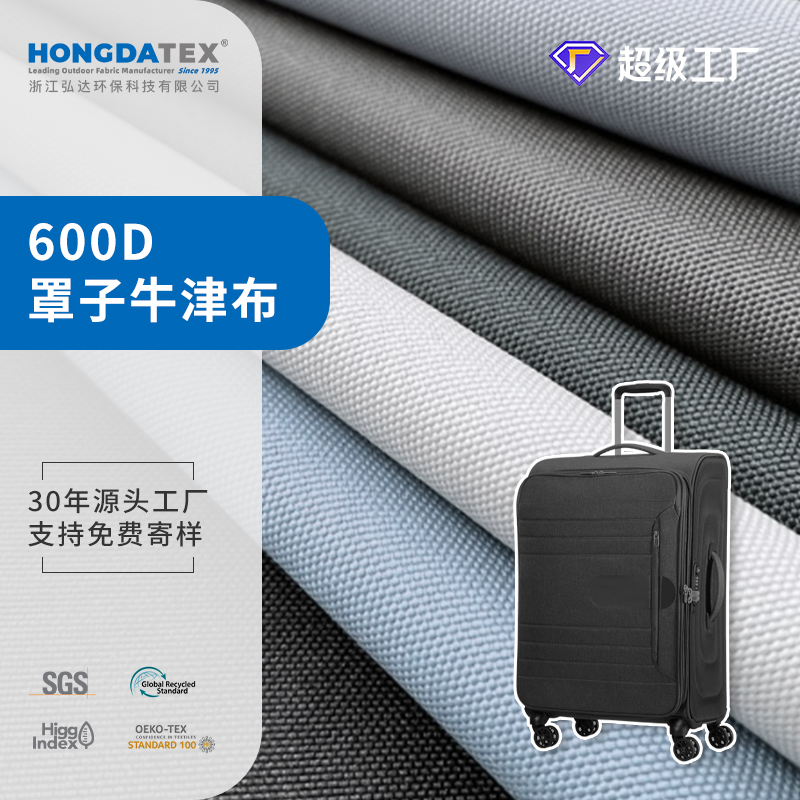
For backpack projects that specifically require polyester Oxford fabric, Zhejiang Hongda Environmental Protection Technology Co., Ltd. (HongdaTEX) can be included in the inquiry shortlist. Its confirmed core manufactured product category is polyester Oxford fabric. Its major processes include weaving, dyeing, printing, heat setting, and coating, and bags and luggage are within its confirmed application scope.
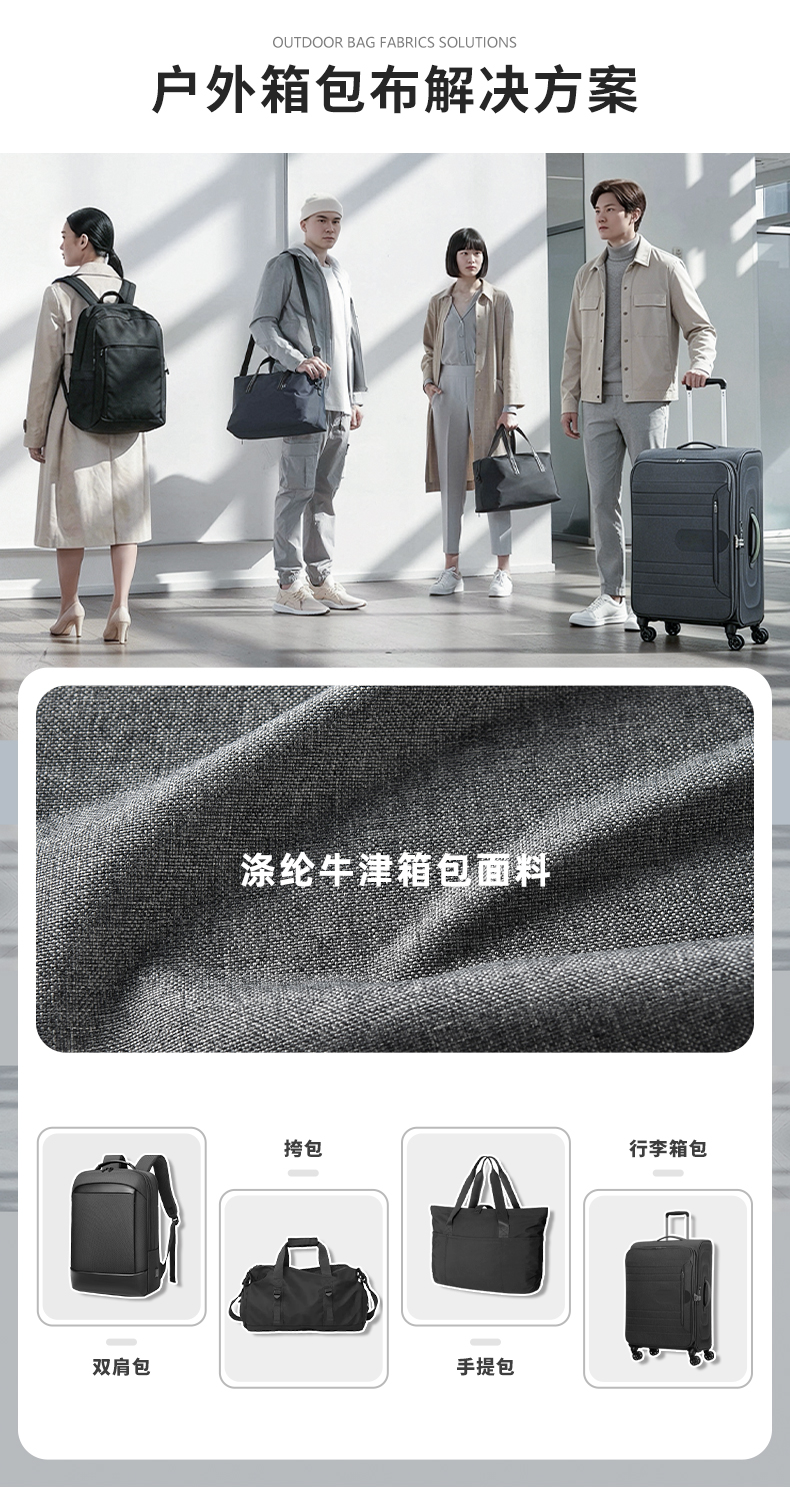
The company’s Bag Fabrics category lists school bags, sport bags, outdoor bags, and luggage. This provides a starting point for reviewing the product direction, but it does not replace a construction-specific specification sheet or test report.
This information supports category-level consideration. It does not confirm that every 300D or 600D construction, waterproof requirement, load-related requirement, or delivery condition is available for a particular order. Buyers should submit the backpack design and fabric requirements for project-level confirmation.
When a design specifies nylon Oxford fabric, retain that material requirement and verify the supply arrangement separately. Confirmed polyester Oxford manufacturing should not be treated as evidence of in-house nylon fabric production.
Confirm the Delivery Condition Before Evaluating Manufacturing Capability
An inquiry should state whether the buyer needs base fabric, finished coated fabric, or a laminated material. The sample and acceptance criteria should correspond to the requested delivery condition.
| Purchasing Requirement | Information to Confirm With the Supplier | Sample Review Priority |
|---|---|---|
| Base fabric that requires further processing | Material, warp/weft specification, density, weave, and responsibility for subsequent processing | Do not treat a base-fabric sample as approval of the finished coated product |
| Fabric with PU, PVC, or another specified finish | Finishing requirements, finished weight, usable width, and performance conditions | Review appearance, hand feel, and performance in the actual delivery condition |
| Material requiring lamination to a backing | Responsibility for the face fabric, backing, lamination, and acceptance | Evaluate the complete laminated construction rather than only the face fabric |
For example, when sourcing PU-coated polyester Oxford fabric for a backpack body, ask the supplier to state whether the quotation includes coating, whether the quoted weight is measured after coating, and whether the submitted sample matches the proposed delivery construction.
Buyers should also ask which relevant processes are performed by the supplier and which are subcontracted, together with who will investigate discrepancies. Factory photographs or a description of one production process do not establish that every process for the order is performed by the same company.
How Should 300D and 600D Be Written Into a Backpack Specification?
The “D” in 300D and 600D refers to denier, a unit of yarn linear density. It is not a finished fabric weight, abrasion rating, or backpack load rating. The actual warp and weft yarn specifications should still be confirmed separately.
Buyers can use 300D or 600D as candidate specifications without assuming that either is suitable for every backpack. A more complete product definition is:
Backpack type and fabric location + fiber material + warp/weft yarn specification + density + weave + finished weight and tolerance + usable width + color requirements + finishing + performance acceptance criteria.
For a commuting backpack, start by explaining the target product weight and appearance. For a backpack carrying tools or outdoor equipment, also describe the contents, operating environment, and contact areas. Ask the supplier to propose candidate constructions against those requirements, then validate them instead of ranking materials by denier alone.
Why Should Fabric, Sewn Components, and the Finished Backpack Be Evaluated Separately?
Material tests and finished-product tests answer different questions. SATRA’s luggage-testing guidance separately discusses outer materials, threads, reinforcement, fittings, and complete products. Fabric results therefore should not be substituted for finished-backpack results.
Fabric Level: Verify the Material Against the Project Requirements
Select abrasion, tear, tensile, and color requirements according to the intended fabric location. The main body, bottom panel, and clothing-contact areas can have different validation priorities rather than automatically sharing one set of criteria.
Sewn-Component Level: Verify the Material Combination and Attachment
For shoulder-strap roots, handle attachments, and bound edges, consider component samples made with the proposed fabric, sewing thread, and reinforcement. Approval records should identify the construction and material combination rather than relying only on an unsewn fabric sample.
Finished-Backpack Level: Verify Performance Under Load
When the project requires load-bearing or repeated lifting evaluation, define the loading conditions and finished-product test approach. SATRA’s handle testing, for example, evaluates loaded luggage and its attachment structure; it does not convert the strength of a fabric specimen into a finished-product load rating.
Responsibilities can be organized accordingly: the fabric supplier confirms the fabric specification and relevant supporting documents, while the backpack manufacturer arranges component and finished-product validation for the actual design. Both parties should agree in advance on how issues involving both material and construction will be investigated.
A Test Result Is Useful Only When the Method Fits the Material
When comparing reports, check the standard edition, specimen construction, tested surface, pretreatment, and acceptance criteria. Two reports labeled “abrasion resistance” do not necessarily provide directly comparable cycle counts.
For example, ISO 12947-2:2016 does not apply to coated fabrics, including laminated fabrics. For abrasion of a coated surface, it directs users to the ISO 5470 series. When purchasing PU- or PVC-coated backpack fabric, ask the testing laboratory to confirm the appropriate method for the actual construction rather than automatically applying a requirement intended for uncoated fabric.
Seam tests also have scope limitations. ISO 13935-2:2026 is normally not applicable to coated fabrics, so it should not be assigned to a sewn coated-fabric component without reviewing its applicability.