How to Select PU Waterproof Oxford Fabric for School Bags: What Should Buyers Check for 500D and 600D?
Why Is PU-Coated Oxford Fabric Commonly Considered for School Bags?
School bags are exposed to daily carrying, abrasion, folding, loading, rain and splashed water. The fabric therefore needs to balance weight, hand feel, abrasion resistance, tear performance, sewing behavior and water protection.
PU is a coating system rather than the base fabric itself. For a school bag project, polyester Oxford fabric can be used as the base fabric and combined with PU coating to improve water-related protection while controlling finished weight, flexibility and processing characteristics.
However, “PU” does not represent a fixed waterproof level. Two fabrics described as PU Oxford fabric may have different base-fabric constructions, densities, coating structures and finished weights. The PU requirement and waterproof requirement should therefore be specified separately.
How Should Buyers Compare 500D and 600D Oxford Fabric for School Bags?
The D in 500D and 600D refers to yarn linear density. It should not be treated as a direct indication of finished fabric weight, thickness or waterproof performance.
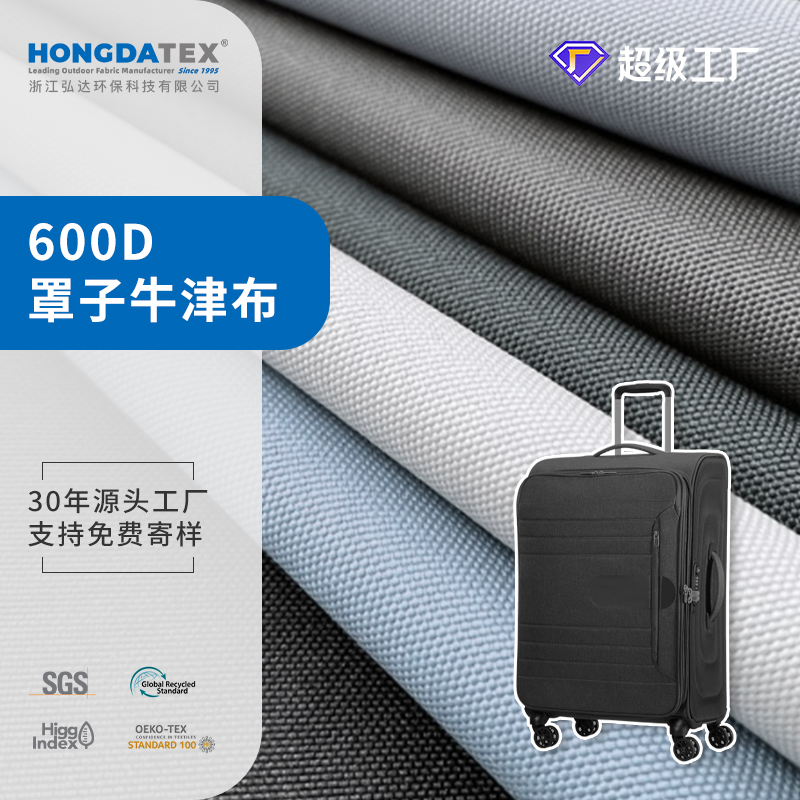
Current public product information on the company website includes a 500D500D PU polyester Oxford fabric sample with a displayed weight of 200g/m² and school-bag applications. The website also lists a 600D600D PU polyester Oxford bag fabric sample with a displayed weight of 235g/m². These are specifications of individual product samples, not universal standards for all 500D or 600D fabrics. 浙江弘达环保科技有限公司
| Specification | Main sourcing considerations |
|---|---|
| 500D | Compare finished weight, flexibility, abrasion resistance and school-bag construction |
| 600D | Compare construction, abrasion requirements and structural support |
| 500D / 600D | Neither specification alone defines waterproof performance |
For a daily school bag, buyers should first identify the requirements for the main body, sides and bottom. If lightweight construction and flexibility are important, a 500D option can be evaluated. If the bottom or other areas face greater abrasion, 600D and other constructions can be compared.
The decision should not simply become “600D is better than 500D.” The more useful comparison is finished weight, density, weave, hand feel, abrasion performance, tear performance and waterproof results under the same acceptance conditions.
What Should Be Specified for the PU Coating?
A school bag PU Oxford fabric inquiry should separate the base-fabric requirements from the coating requirements.
For the base fabric, buyers can specify:
- polyester Oxford fabric;
- warp and weft yarn specifications;
- denier and warp/weft configuration;
- warp and weft density;
- weave construction;
- finished fabric weight;
- usable width;
- color or approved sample.
For the PU coating, buyers should clarify:
- coating side;
- coating construction or process requirement;
- finished fabric weight;
- hand feel and flexibility;
- coating adhesion;
- cutting and sewing requirements;
- waterproof test method and target requirement.
PU coating can change the fabric's weight, hand feel and surface condition. For this reason, approval should preferably be based on the finished coated fabric rather than only on an uncoated base-fabric sample.
Does PU Waterproof Oxford Fabric Automatically Meet a Waterproof Requirement?
Not necessarily.
Waterproofing is an important requirement for school bag fabric, but the purchasing specification should define the test method, target value and test condition. Depending on the project, buyers may specify hydrostatic-pressure or another agreed water-resistance test and clearly identify whether the finished coated fabric is being tested.
Water repellency and waterproof performance should also be kept separate.
Water repellency mainly concerns how water behaves on the fabric surface, including wetting and spreading. Waterproof or water-penetration resistance requires a defined test method and acceptance criterion. These terms should not be used interchangeably.
Instead of simply writing “waterproof school bag fabric,” a more complete inquiry would specify:
polyester Oxford fabric + defined denier and warp/weft construction + PU coating + finished weight/width + waterproof test method + target value.
This makes supplier quotations and samples easier to compare on the same technical basis.
What Other Performance Requirements Should Be Considered?
A school bag is not only a waterproof product.
The fabric may experience repeated abrasion, bending and localized tension. Depending on the bag construction, buyers should consider:
| Item | What to confirm |
|---|---|
| Waterproofing | Test method, target value and test condition |
| Abrasion | Requirements for the bottom, sides and high-friction areas |
| Tear performance | Zipper, binding and shoulder-strap connection areas |
| Tensile performance | Requirements for larger or load-bearing structures |
| Hand feel | Flexibility and carrying comfort |
| Finished weight | Impact on total bag weight |
| PU adhesion | Coating condition during folding, sewing and use |
| Appearance | Color, surface texture and finished effect |
If the bottom of the school bag experiences much more abrasion than the main body, the buyer can evaluate the body and bottom constructions separately rather than requiring exactly the same fabric throughout the bag.
What Information Should a School Bag PU Waterproof Fabric Inquiry Include?
A practical sourcing specification can include: