How to Source Tear-Resistant Oxford Fabric for Bags: Denier Alone Is Not Enough
Why should tear resistance be specified separately for bag fabrics?
Backpacks, school bags, travel bags, soft luggage and tool bags are exposed to pulling, folding and localized stress during use.
Areas where a small cut or damaged point may become important include:
- zipper and opening areas;
- handle and shoulder-strap attachment zones;
- corners and folds;
- areas exposed to pressure from hard contents;
- surfaces repeatedly rubbed against floors or other objects.
Tear resistance is therefore different from simply asking how much tensile load an intact piece of fabric can withstand.
ASTM D2261 specifically measures tear strength after a tear has already been initiated, and the standard notes that its reported value is not directly related to the force required to initiate a new tear.
For bag sourcing, tear strength, tensile strength and finished seam performance should therefore not be treated as the same property.
Does a higher denier automatically mean better tear resistance?
No.
The “D” in 300D, 600D or 900D means denier, a measure of yarn linear density. A higher denier identifies a different nominal yarn size, but it does not independently establish the tear strength of the finished Oxford fabric.
Two fabrics described as 600D Oxford may differ in:
| Variable | What the buyer should clarify |
|---|---|
| Yarn specification | Actual warp and weft yarn construction |
| Fabric density | Warp and weft yarn counts/density |
| Weave | Plain, twill or another structure |
| Finished weight | Record it separately rather than infer it from denier |
| Finishing | PU, PVC or other coating requirements |
| Test direction | Warp and weft results |
| Test method | The agreed tear test standard |
If a buyer is comparing 300D, 600D and 900D Oxford fabrics for bags, it is more useful to compare actual test results under the same agreed test method and conditions rather than rank the fabrics only by denier.
Which fabric-construction factors matter when evaluating tear resistance?
1. Do not describe the entire construction with one denier number
A label such as “600D Oxford” may not fully describe both warp and weft construction.
A purchasing specification should identify the warp and weft yarns and the relevant fabric structure as clearly as possible.
Tear results should also identify the test direction. For a woven fabric, warp and weft performance may differ, so one unqualified number is not always sufficient for acceptance.
2. Higher density does not automatically mean higher tear strength
A denser construction changes yarn interaction and fabric structure, but it should not automatically be interpreted as higher tear resistance.
During tearing, yarn movement, load concentration and weave geometry all affect how the fabric behaves.
“High-density Oxford” is therefore a construction description, not a substitute for measured tear performance.
3. Plain and twill constructions should be evaluated in the finished condition
Different weave structures create different yarn-interlacing patterns.
If tear resistance is a required property, the selected weave should be tested after the final fabric construction and finishing have been determined rather than predicted from the words “plain weave” or “twill” alone.
Does coating automatically improve the tear resistance of Oxford fabric?
Not necessarily.
Bag Oxford fabrics may use PU coating, PVC coating or another finishing system depending on the end use. A coating changes the finished construction, hand and restraint between yarns, but its effect on tear behavior should be verified on the actual finished fabric.
For purchasing purposes:
a base-fabric tear result should not automatically be treated as the tear result of the coated finished fabric.
Where the final bag uses coated Oxford fabric, acceptance should preferably be based on the material in its actual production condition.
ASTM D1424-25 uses a falling-pendulum Elmendorf-type apparatus to determine the force required to propagate a single-rip tear from a cut. Its scope includes many fabrics, including coated and otherwise treated materials.
Which test method should be used for tear-resistant Oxford fabric?
This is a critical part of an RFQ.
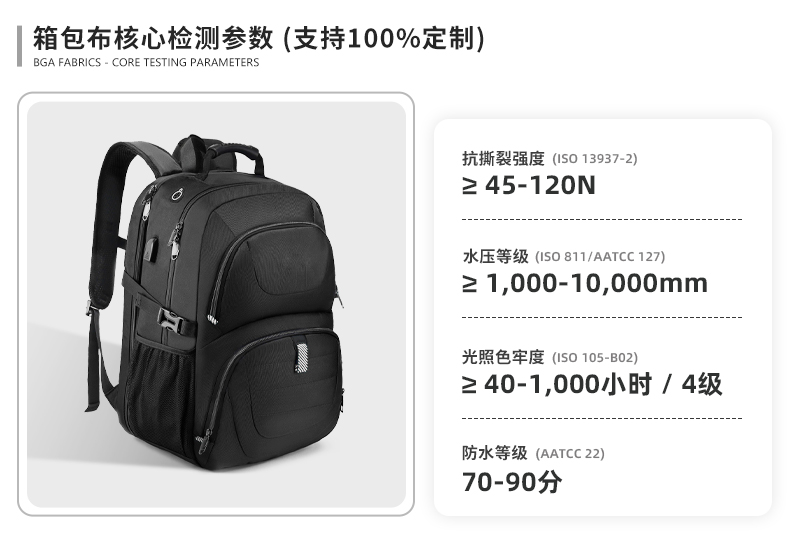
A specification such as “tear strength: XX N” is incomplete if the test method is not identified, because textile tear strength can be measured using different specimen configurations and equipment.
Elmendorf pendulum method
ISO 13937-1 covers the determination of fabric tear force using the ballistic-pendulum, or Elmendorf, method. ISO states that ISO 13937-1:2000 was reviewed and confirmed in 2023 and remains current.
ASTM D1424 also uses an Elmendorf-type falling-pendulum apparatus. The current ASTM listing is D1424-25.
Trouser or tongue tear methods
ISO 13937-2 covers a single-tear method using trouser-shaped specimens and was also confirmed in 2023.
ASTM D2261 uses a tongue single-rip procedure with a constant-rate-of-extension tensile testing machine. ASTM currently lists D2261-13(2024) as active.
Because these methods use different specimen geometries, equipment and measurement procedures, values from different methods should not be treated as directly interchangeable purchasing results.
A stronger specification states:
test standard + applicable version or customer method + warp/weft direction + target value + specimen condition.
Should every type of bag use the same tear-strength requirement?
No single requirement should automatically be applied to every bag category.
School bags and everyday backpacks: weight, hand feel, abrasion and tear performance need to be balanced rather than maximizing one property in isolation.
Travel bags and soft luggage: repeated loading, folding and contact with other surfaces make it useful to evaluate tear resistance together with abrasion and tensile requirements.
Tool bags: hard or metal contents can create more concentrated local loads, so fabric construction and reinforcement requirements should be defined according to the finished product.
The useful sourcing question is therefore not:
“Which denier has the highest tear strength?”
It is:
“Where and under what conditions is this bag exposed to tear propagation, and what Oxford construction and test requirement should be used to control that risk?”
What information should a tear-resistant Oxford fabric RFQ include?
A practical RFQ can include: